The Zero-Click Reality: How to Optimize Your Website for AI Search (GEO)

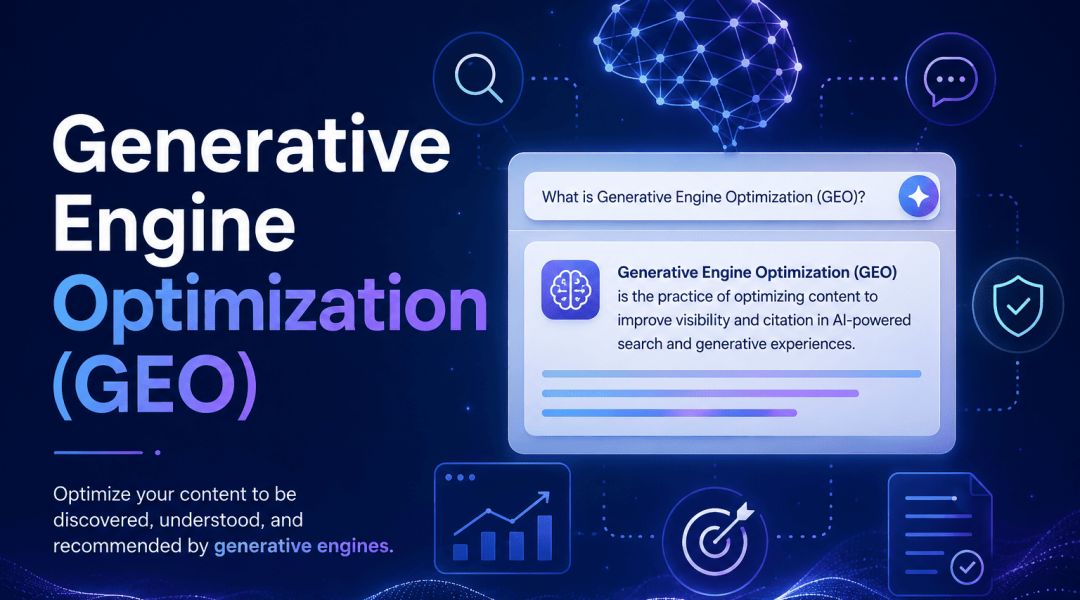
Do you observe that even your rankings are good but traffic to your website is getting harder to gain? You’re not mistaken. SEO is a traditional game that has been broken forever, and a new reality has emerged.
Consider how you search for information. If you ask Google a question today, you’ll encounter an AI Overview at the top of the page summarizing the answer. People who use tools such as ChatGPT, Gemini, or Perplexity receive their answer directly in conversation with the tool. In either case, you’ll get just what you need without ever having to click through to a single site.
So if the people don’t click, is SEO redundant? Not at all. However, the rulebook has been totally revised. The days of conventional Search Engine Optimization have passed and we are now in the age of GEO: Generative Engine Optimization.
What you have to do now, is not just optimize your website for an algorithm that ranks links, but optimize your site so that large language models (LLMs) select your brand as the one they trust to call out. Let’s dive into how to adapt your digital marketing to beat the AI-powered search engine.
A long time ago, the basic SEO strategy was to pick a popular keyword and write a lengthy article about it. The problem? Thousands of blogs did just that, producing a flood of copycat, basic content. AI models have already read all of that general text, they don’t need more of it.
With Generative Engine Optimization, your content should give Information Gain to get a ranking in AI search Summaries. It is a concept that Google actually patented and it is the extent to which your page provides new information to the table as opposed to information that is already available.
The strategy: Don’t write articles about general things like “What is…”. Rather, use proprietary data, unique case studies from your own experience, or a contrarian perspective based on your own experience. AI engines are very biased towards the latest and original sources. The more likely it is that the AI will reference and attribute to you, the more likely you are to be the source of a specific insight.
In Generative Engine Optimization (GEO) if you have an AI agent pulling data from your website and showing it to a user, you’ll need to make the backend data of your site super easy to be processed by a machine. Humans read your beautiful web design, AI bots read your code.
The Strategy: Focus on Advanced Schema Markup (Structured Data). This is the code that you can include in your site which clearly communicates to search engines the meaning of your data. Use specific schema for articles that include author, services rendered, local business info and product FAQs rather than relying on the basic article schema. If the data is properly organized, AI engines can readily retrieve the information to include in its summaries.
With the ability to churn out a slew of generic blog posts with just a click of an AI button, human authenticity is now a valuable economic asset in the digital landscape. AI search models are designed to identify indicators of trust and authority in real-world scenarios.
The Strategy: Cultivate the personal brand or the founder’s image on other mediums than a blog, such as LinkedIn or video sites. If real humans begin to search for your particular name or website directly (such as searching for “branded searches”), AI engines notice it. They know that you’re not just some random website, but a well-known expert in your field, increasing your overall AI-generated answer presence.
If you are only evaluating your digital marketing based on the number of traffic sessions you’re getting on your website, you are measuring the wrong things. As in a world without clicks, any citation that is included in an AI response is as significant as a direct click. In the era of Generative Engine Optimization focus on inclusion in AI responses to get visibility.
Fighting the bots is not the way to go; instead, it’s better to feed them.
So, the shift from Search Engine Optimization (SEO) to Generative Engine Optimization (GEO) is not a battle against AI summaries, but rather a strategic move towards making yourself the ultimate source from which they draw. You’ll focus on quality, original content and cleanly organized your site for machines to read, so your brand will remain visible as technology changes.
The future of search is in the hands of the ones who offer real and irreplaceable human perspective. What special knowledge does your business have to offer?
2026 All Rights Reserved | Powered by Rahul Babu